Silverback Project
Northwestern Ontario | Cu–Au–Ag & Ni–Cu Exploration
- 4,760 hectares in one contiguous block
- 3.5 km multi-metal mineralized corridor
- Up to 9.5 g/t Au and 5.6% Cu in shear-hosted outcrop
- 1.2 km near-surface IP anomaly (Central Zone)
- Dual mineral systems: Orogenic + Magmatic
Overview
Lac de Mille Lacs Greenstone Belt | Ontario, Canada
A structurally controlled copper–gold–silver system overprinting a magmatic nickel–copper intrusive complex within a proven gold and nickel district in Northwestern Ontario.
Silverback spans a 3.5-kilometre mineralized corridor at the northern margin of the Lac de Mille Lacs greenstone belt, where northeast-trending shear zones intersect late mafic–ultramafic intrusions. The project combines intrusion-related copper–gold mineralization with magmatic nickel–copper hosted in layered mafic-ultramafic bodies.
Location and access
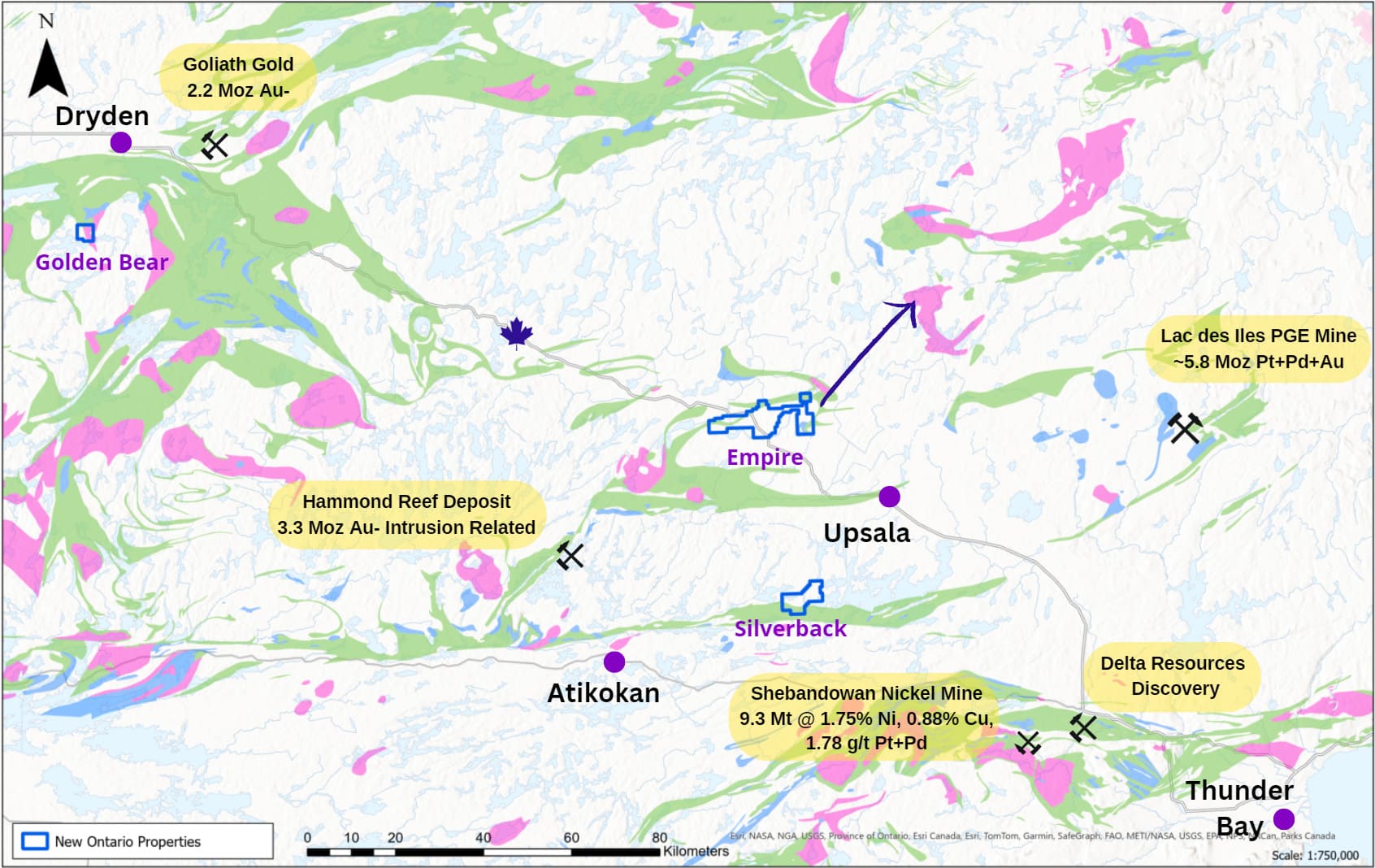
Silverback is located on the west side of Lac des Mille Lacs in Northwestern Ontario, approximately:
• 120 km northwest of Thunder Bay
• 62 km northeast of Atikokan
The project benefits from year-round road access via logging roads from TransCanada Highway 17 and Highway 11, providing direct access to the central claim block.
Silverback is situated within an established mining jurisdiction with regional infrastructure, skilled workforce availability, and proximity to operating and past-producing gold and nickel operations in the western Wabigoon Subprovince.
Geological setting
Silverback straddles the Lac de Mille Lacs greenstone belt and the tonalitic Marmion Terrane within the central Wabigoon Subprovince of the Superior Craton.
Exploration in the district has historically been limited due to extensive glacial till and lake sediment cover.
The mafic to ultramafic intrusions in the Lac des Mille Lacs area are geologically related to the Quetico suite.
The project is positioned within northeast-trending structural corridors interpreted as splays off the Marmion Shear Zone — a major regional gold-controlling structure.
Exploration history
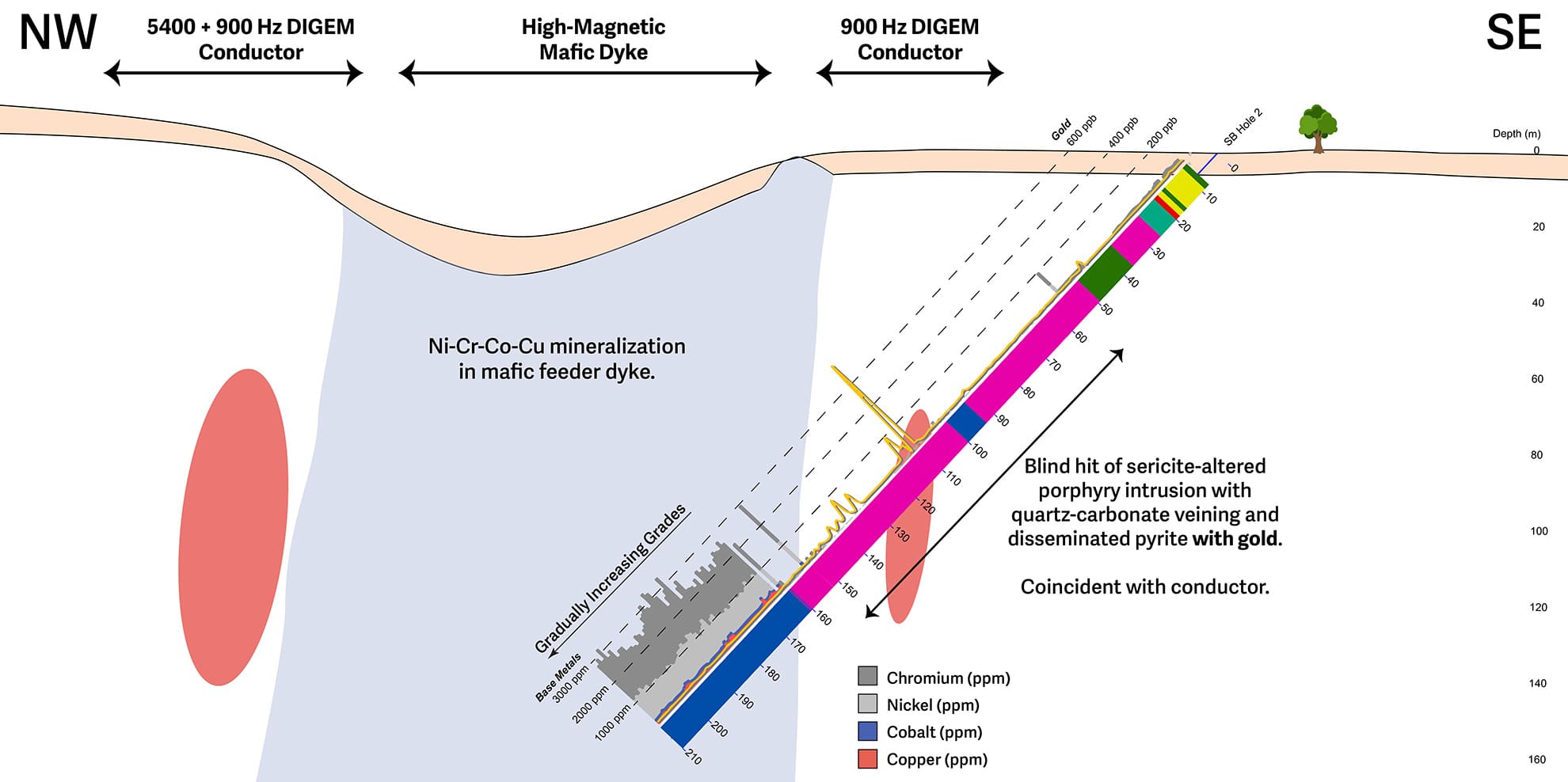
A two-hole, 314-metre maiden drill program completed in Spring 2024 tested near-surface conductors identified in the 2023 airborne DIGEM survey.
Key results included:
• 109 metres of anomalous gold in sericite-altered porphyry
• Disseminated pyrite mineralization
• Nickel and chromium mineralization in adjacent mafic-ultramafic dyke
Drilling validated:
• An intrusion-related copper-gold model
• A structurally controlled shear-hosted gold model
• Magmatic nickel potential
Dual-System Structural Corridor
Orogenic + Magmatic Overprint
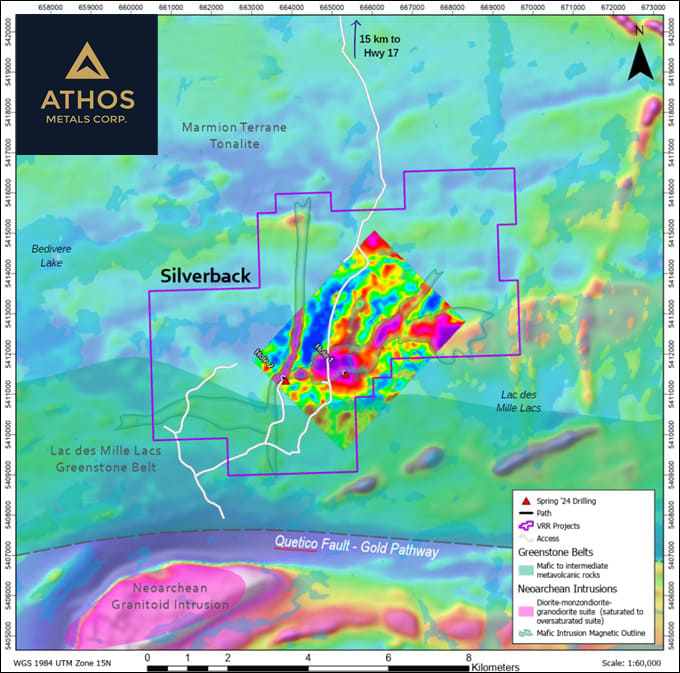
Silverback spans a 3.5-kilometre mineralized corridor along the northern margin of the Lac de Mille Lacs greenstone belt, where northeast-trending shear zones intersect layered mafic–ultramafic intrusions.
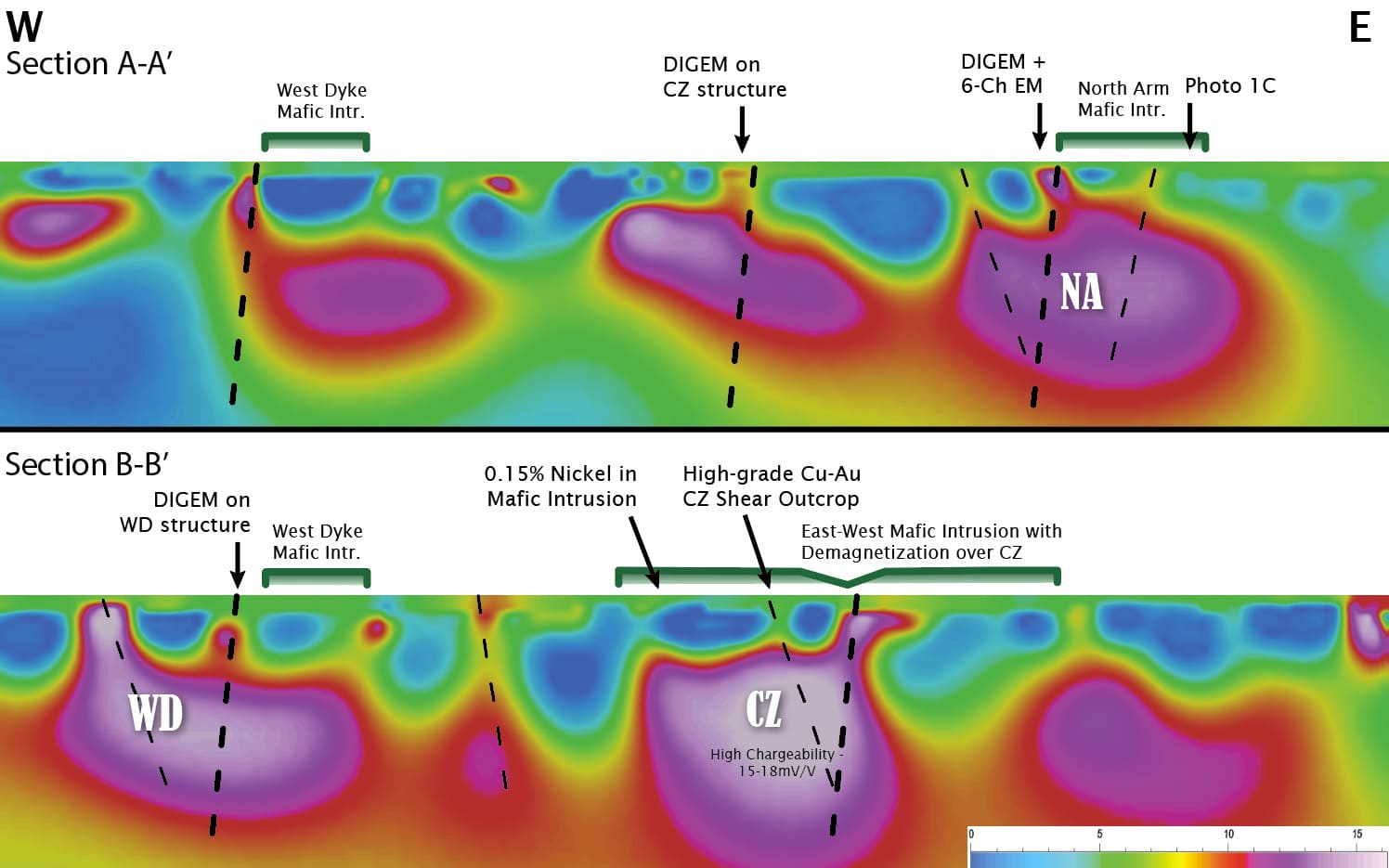
Integrated airborne magnetics, DIGEM electromagnetics and 3D DCIP surveys define coincident chargeability and conductivity anomalies along these structural corridors.
The scale and structural continuity of this corridor support potential for:
• Shear-hosted copper–gold–silver mineralization
• Magmatic nickel–copper sulphide mineralization
• Intrusion-related copper–gold systems
Several high-priority IP anomalies remain untested.
Why Silverback?
Positioned at the Intersection of Gold and Nickel Systems
Silverback offers:
• Dual mineral systems (orogenic + magmatic)
• High-grade surface copper–gold occurrences (up to 9.5 g/t Au, 5.6% Cu)
• 1.2 km near-surface IP anomaly
• 3.5 km multi-metal mineralized corridor
• Road access in an established mining jurisdiction
Silverback represents a structurally controlled exploration platform within the western Wabigoon Subprovince with scalability along strike.
Central Zone (CZ)
Drill-Defined Structural Target
The Central Zone represents the most advanced target within the Silverback Project.
A 1.2-kilometre high-amplitude IP anomaly follows a north–south structural break identified in magnetic data and coincides with sheared gabbro hosting high-grade copper–gold mineralization at surface.
The anomaly extends to surface beneath shallow glacial cover and remains open along strike.
Maiden Drilling (2024)
A two-hole, 314-metre program tested near-surface conductors derived from the 2023 DIGEM survey.
Drilling intersected:
• 109 metres of anomalous gold in sericite-altered porphyry
• Disseminated pyrite mineralization
• Nickel–chromium mineralization in adjacent mafic-ultramafic dyke
Results validated both structural and intrusive mineralization models.
Geological model
Shear-Hosted + Intrusion-Related System
Silverback is interpreted to represent a structurally controlled copper–gold–silver system overprinting a layered mafic–ultramafic intrusive complex.
Surface sampling and drilling confirm:
• Sheared feldspar porphyry with gold mineralization
• Remobilized copper, gold and molybdenum along northeast shear zones
• Magmatic nickel–chromium mineralization in feeder dykes
The presence of molybdenite supports an intrusive source for copper and gold mineralization and indicates high-temperature fluid flow within regional shear systems.
Geophysical data demonstrates strong correlation between structural breaks, magnetic troughs and IP chargeability highs.
Exploration Strategy
Systematic Testing of High-Amplitude IP Targets
Athos’ exploration strategy is focused on:
- Drill-testing the 1.2 km Central Zone IP anomaly
- Expanding drilling along the 3.5 km mineralized corridor
- Testing additional conductivity anomalies identified in DIGEM surveys
- Refining structural architecture through integrated 3D DCIP interpretation
The objective is to evaluate both shear-hosted gold potential and magmatic nickel–copper sulphide mineralization across the property.
Gallery