
Technical Series | Part 3
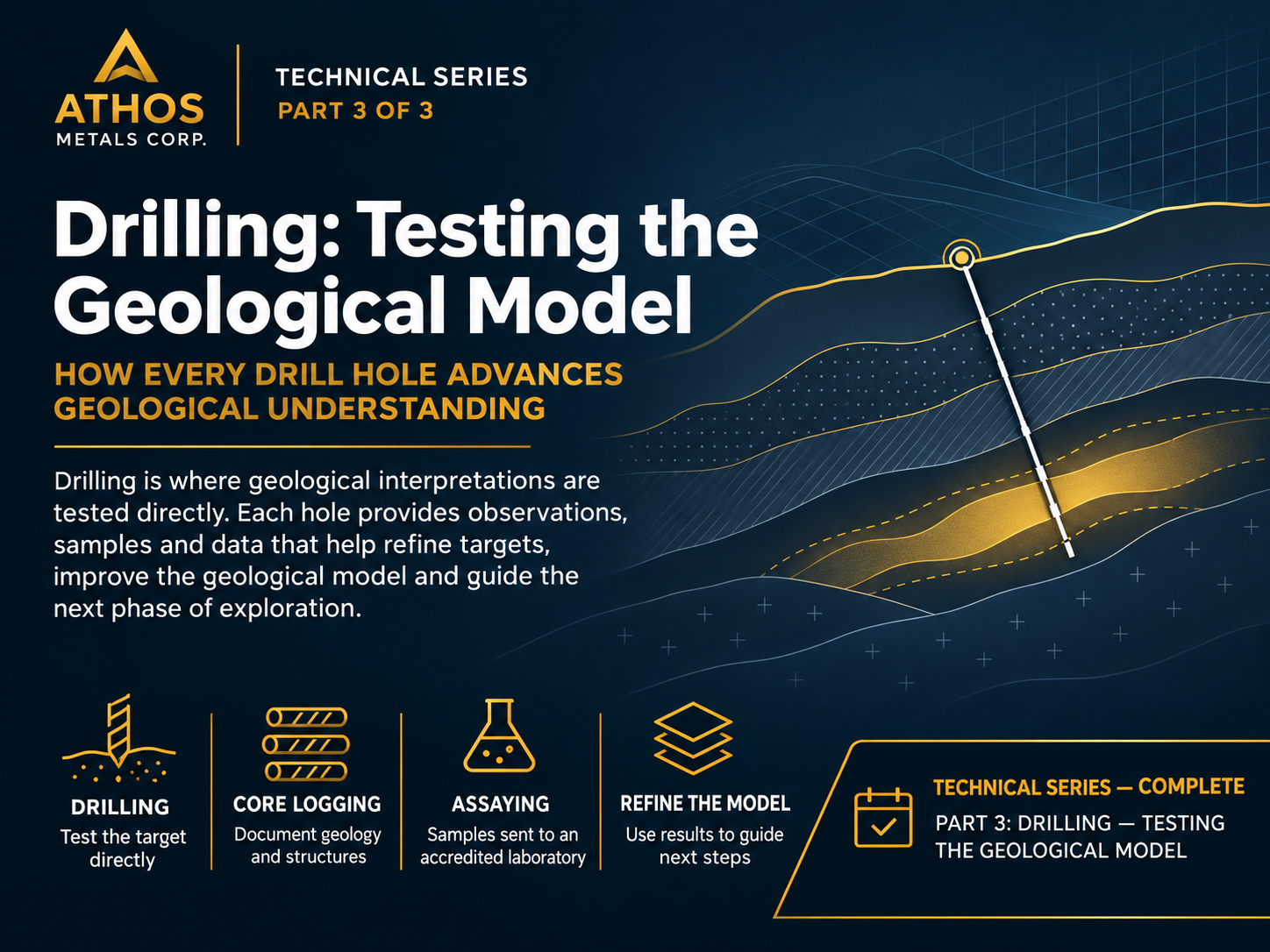
Drilling: Testing the Geological Model
How Every Drill Hole Advances Geological Understanding
Athos Insights | Technical Series | Part 3
In Part 1 of the Athos Insights Technical Series, we examined the geological and geophysical characteristics that help define a strong exploration target. Part 2 explored how these separate lines of evidence are integrated to prioritize where drilling should begin.
Part 3 brings that process to its most direct test: drilling. Beneath the surface, geological interpretations become observations that can be measured, sampled and compared with the original exploration model. The purpose is not simply to find mineralization in a single hole, but to make better-informed decisions with each stage of exploration improving our understanding of subsurface geology.
Drilling as a Scientific Test
Before a drill rig arrives on site, geologists have already developed a working interpretation of the subsurface. Geological mapping identifies the rocks and structures exposed at surface. Geophysical surveys help outline concealed features, while historical drilling and geochemical results provide additional context. Together, these datasets guide the selection of a drill-hole location, direction, inclination and depth.¹
Each hole is designed to test specific questions: Does the predicted intrusion occur where the model suggests? Is a conductive feature related to sulphide minerals or another geological source? How do rock contacts and structures change with depth? Do the observations support the model, or does the interpretation need to change?
The answers matter because a geophysical response is not, by itself, evidence of an economic mineral deposit. Drilling tests the geology responsible for that response and helps geologists distinguish between competing interpretations.
What Happens After the Drill Bit Reaches Bedrock?
In diamond drilling, a rotating drill bit cuts a cylindrical sample of rock known as drill core. The recovered core is placed in labelled boxes so geologists can examine a physical record of the rocks intersected beneath the surface. Although core recovery and the quality of the record can vary, it provides direct information that airborne surveys cannot supply.²
The core is then logged: geologists document rock types, contacts, textures, alteration, fractures, structures and visible mineralization. They also record the position and characteristics of intervals selected for laboratory analysis. Photographs and measurements preserve information that can be revisited as the geological model develops.²
Selected samples will be sent to an accredited laboratory to measure their metal content. These results, commonly called assays, are essential because the appearance of sulphide minerals alone does not establish the grade or economic significance of a drill intersection. Quality-assurance and quality-control procedures help assess the reliability of the analytical data.²
Why a Hole Without Significant Mineralization Can Still Matter
Exploration results are often described as successful or unsuccessful according to whether a drill hole intersects significant grades. From a technical standpoint, the outcome can be more nuanced.
A hole may confirm the predicted rock unit but show that a conductor was caused by a different mineral or geological feature than expected. It may establish that a target lies deeper than interpreted, that a contact changes orientation, or that a favourable intrusion does not continue in the direction originally proposed. Each observation can help narrow the remaining possibilities.
This does not mean every drill hole is equally valuable or that a lack of mineralization is a positive result. Drilling requires substantial investment, and an unsuccessful test can limit the potential of a particular target. Its scientific value depends on whether the information collected answers a useful question and helps guide the next decision.
From Drill Results to a Better Geological Model
Modern mineral exploration is an iterative process. Once core logging and assay results are available, geologists compare the observed geology with the original predictions and update their interpretations. Drill-hole information can be incorporated into maps, cross-sections and three-dimensional geological models to refine the location, geometry and continuity of important features.¹ ²
In some cases, the results may justify additional drilling to test an interpreted extension or a new target. In others, they may indicate that a different area deserves priority, or that no further work is warranted at that location. The objective is to progressively reduce geological uncertainty while making responsible use of exploration capital.
Applying the Approach at Athos Metals
Athos Metals is using a systematic exploration approach at its Empire District Project in northwestern Ontario. At the Westwood target, previously reported drilling intersected layered mafic-ultramafic intrusive rocks and disseminated sulphide mineralization, providing direct geological observations that can be assessed alongside geophysical data.³
The Company also completed approximately 1,756 line-kilometres of VTEM Plus airborne electromagnetic and magnetic surveying in 2026. This dataset provides additional information for interpreting conductive and magnetic features and refining future exploration targets.⁴
Athos update (November 20, 2026). Athos Metals Corp. (TSXV: ATHO) has moved from exploration planning toward drill execution. The Company completed its Qualifying Transaction with Meed Growth Corp. and began trading on the TSX Venture Exchange on November 18, 2026, closed approximately $1.68 million in financing, and signed a drilling services agreement with Rodren Drilling Ltd. for a Phase 1 diamond drill program of at least 2,000 metres, expected to begin in January 2027. Building on the completed 1,756 line-kilometre VTEM Plus survey and follow-up modelling, the technical team is ranking priority targets across the Empire, Rambler and Mack properties. The upcoming program will test these geological interpretations directly, with core observations and assay results informing the next exploration decisions.⁵
Although the Phase 1 program is contracted and funded, its timing and execution remain subject to logistics, weather, access and other operational considerations. Electromagnetic and magnetic anomalies are exploration targets only; they do not necessarily indicate mineralization or an economically viable mineral deposit.
The Bigger Picture
The three parts of this series describe a connected process:
- Identify the geological setting,
- Integrate evidence to select targets
- Use drilling to test those interpretations.
Discovery is rarely the result of one dataset or one drill hole. It develops through disciplined observation, careful interpretation, direct testing and an ongoing willingness to revise the geological model when new evidence emerges.
For investors, understanding this process provides a more useful perspective on exploration results. A drill program is not only a search for mineralization; it is a structured effort to determine what the rocks reveal and what exploration decisions should follow. Long before a mineral deposit can be defined, the geological system must first be understood.
About Athos Insights
Athos Insights is an educational series published by Athos Metals Corp. exploring the science, technologies and methods used in modern mineral exploration. These articles provide general educational information and are not a substitute for the Company’s technical disclosures.
Sources
¹ Canadian Institute of Mining, Metallurgy and Petroleum (2018), CIM Mineral Exploration Best Practice Guidelines. https://mrmr.cim.org/media/1163/cim-mineral-exploration-best-practice-guidelines-2018.pdf
² CIM Mineral Exploration Best Practice Guidelines, sections on drilling, core logging, sampling and analytical QA/QC. Same link source as above.
³ Athos Metals Corp., Empire District Project Overview. https://athosmetals.com/empire-district/
⁴ Athos Metals Corp. (June 17, 2026), Athos Metals Completes District Scale VTEM Plus Airborne Survey over Empire District Project in Ontario and Stakes Additional Claims. https://athosmetals.com/athos-metals-completes-district-scale-vtem-plus-airborne-survey-over-empire-district-project-in-ontario-and-stakes-additional-claims/
⁵ Athos Metals Corp. (November 18, 2026), Athos Metals Corp. Provides CEO Update: Begins Trading on the TSXV and Phase 1 Drill Program Set for January 2027. https://athosmetals.com/athos-metals-corp-provides-ceo-update-begins-trading-on-the-tsxv-and-phase-1-drill-program-set-for-january-2027/
Forward-Looking Information
This article contains forward-looking statements and forward-looking information within the meaning of applicable Canadian securities laws. Such statements include, but are not limited to, the Company’s strategy, objectives, exploration plans and anticipated activities; target prioritization; the size, scope and timing of the planned Phase 1 drill program, including the anticipated January 2027 start; and expectations regarding exploration results, assay reporting and engagement with Lac des Mille Lacs First Nation. Geophysical anomalies do not necessarily indicate the presence of mineralization, and interpretation of exploration data is subject to uncertainty.
Forward-looking information is based on management’s current expectations, assumptions and beliefs, including assumptions about regulatory approvals, personnel and equipment availability, permits, field access, weather conditions and the Company’s ability to execute its business plans. Actual results and timing may differ materially because of known and unknown risks, including the speculative nature of mineral exploration, uncertainty of geological interpretations and drill results, the absence of a mineral resource estimate, logistical or permitting delays, commodity price fluctuations and general economic, market and business conditions.
Readers should not place undue reliance on forward-looking statements, which speak as of the date of publication. The Company undertakes no obligation to update or revise such statements except as required by applicable law or the policies of the TSX Venture Exchange.