
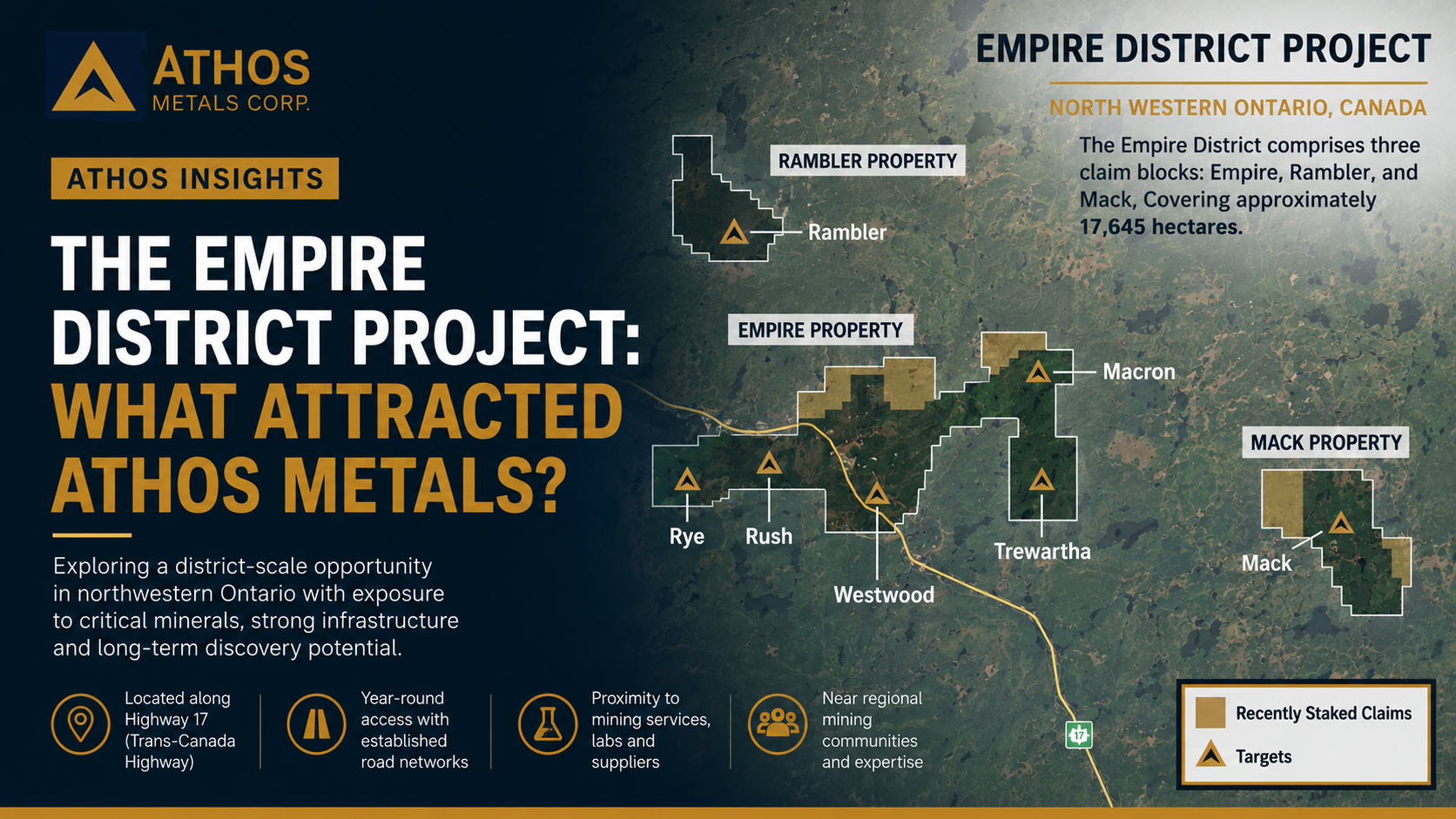
The Empire District Project: What Attracted Athos Metals?
When Athos Metals began evaluating exploration opportunities in Canada, management was focused on identifying more than just another exploration project. The goal was to secure a district-scale opportunity in a stable mining jurisdiction with exposure to commodities expected to play an increasingly important role in the global economy for decades to come.
The Empire District Project (the “Empire District Project”) in northwestern Ontario checked every box.
Today, the Empire District Project spans approximately 17,645 hectares across three claim blocks — Empire, Rambler and Mack—and hosts multiple exploration targets prospective for copper, nickel, platinum group elements (PGE) and gold. These commodities are increasingly recognized as critical to global infrastructure, electrification, advanced manufacturing and energy security.
Why Northwestern Ontario?
Location matters in mineral exploration.
Ontario is widely recognized as one of the world’s premier mining jurisdictions, offering established infrastructure, a transparent permitting process, skilled labour, and a long history of successful mine development. For exploration companies, operating in a Tier 1 jurisdiction reduces many of the geopolitical and regulatory risks often associated with mineral projects elsewhere in the world.1
Northwestern Ontario has become a focal point for critical minerals exploration due to its favorable geology and growing strategic importance within Canada’s critical minerals supply chain. The region hosts numerous producing mines, advanced-stage development projects and emerging discoveries, making it one of the most active mineral exploration districts in the country.2
For Athos, the combination of geological potential and jurisdictional advantages made the region highly attractive.
Infrastructure Supports Efficient Exploration
In addition to its geological potential, the Empire District Project benefits from excellent infrastructure that supports efficient, year-round exploration. The Empire District Project is located along Highway 17, the Trans-Canada Highway, approximately 170 kilometres west of Thunder Bay, and is accessible through an established network of forestry roads. Its proximity to a major transportation corridor, regional mining communities, exploration contractors, analytical laboratories and equipment suppliers helps streamline exploration logistics while reducing mobilization time and costs. For Athos, strong infrastructure is another competitive advantage that supports the Company’s long-term strategy of systematically advancing the Empire District Project toward drilling and future discovery.
A District-Scale Opportunity
Management was particularly drawn to the scale of the Empire District Project.
Unlike many early-stage exploration projects that focus on a single prospect, the Empire District Project contains multiple target areas distributed across three separate claim blocks. Historical work, government datasets, geological mapping and modern exploration techniques all point to the potential for multiple mineralized systems within the broader district.
This district-scale approach provides Athos with numerous opportunities to generate discoveries while allowing exploration teams to evaluate multiple targets simultaneously.
The project currently includes multiple priority target areas, including Westwood, Rye, Rush, Trewartha, Rambler, Macron and Mack, each offering distinct geological characteristics and exploration potential.
For Athos, the opportunity was never about a single drill hole or a single target. It was about assembling a land package capable of supporting a long-term exploration strategy with district-scale discovery potential.
Critical Minerals Exposure
The commodities targeted at Empire are another key reason management pursued the acquisition.
Copper remains one of the most important metals for global electrification, renewable energy systems and power infrastructure. Nickel plays a vital role in battery technologies and stainless steel production, while platinum group elements are used in automotive, industrial and emerging clean energy applications.
Gold provides additional exploration upside and diversification within the district.
By targeting a combination of copper, nickel, PGE and gold mineralization, Athos believes the Empire District Project offers potential exposure to several commodities that are expected to remain strategically important in the years ahead.
As governments and industries continue to prioritize domestic critical minerals supply chains, projects located in stable jurisdictions such as Ontario will become increasingly important to future resource development.
Strong Indigenous Partnership Lac De Mill Lac
Responsible mineral exploration begins with building strong relationships with local communities. Another reason Athos targeted the Empire District was the positive relationship VR Resources Ltd. established with the Lac des Mille Lacs First Nation (“LDMLFN”) whose traditional territory covers the Empire District Project. On November 1, 2024, VR Resources and the LDMLFN signed a Memorandum of Understanding relating to early exploration which established the foundation for a collaborative approach to resource development at the Empire District Project (the “MOU”).
Athos believes that long-term project success is built on strong partnerships and mutual respect, and is actively exploring ways to build on the relationship established under the existing MOU.
Validation Through Modern Exploration
Since acquiring the Empire District Project, Athos has focused on applying modern exploration techniques to advance its understanding of the district.
One of the Company’s most significant milestones to date was the completion of a helicopter-borne VTEM Plus airborne geophysical survey conducted by Geotech Ltd. This represents an important step in transforming historical datasets and geological concepts into actionable drill targets. The survey covered the entire Empire District Project and was expanded from 1,654 line-kilometers to 1,756 line-kilometers after preliminary results highlighted additional geophysical anomalies.
Athos staked an additional 1,725 hectares at the Empire Property and 770 hectares at the Mack Property to secure those geophysical anomalies extending beyond the Company’s existing claim boundaries.