
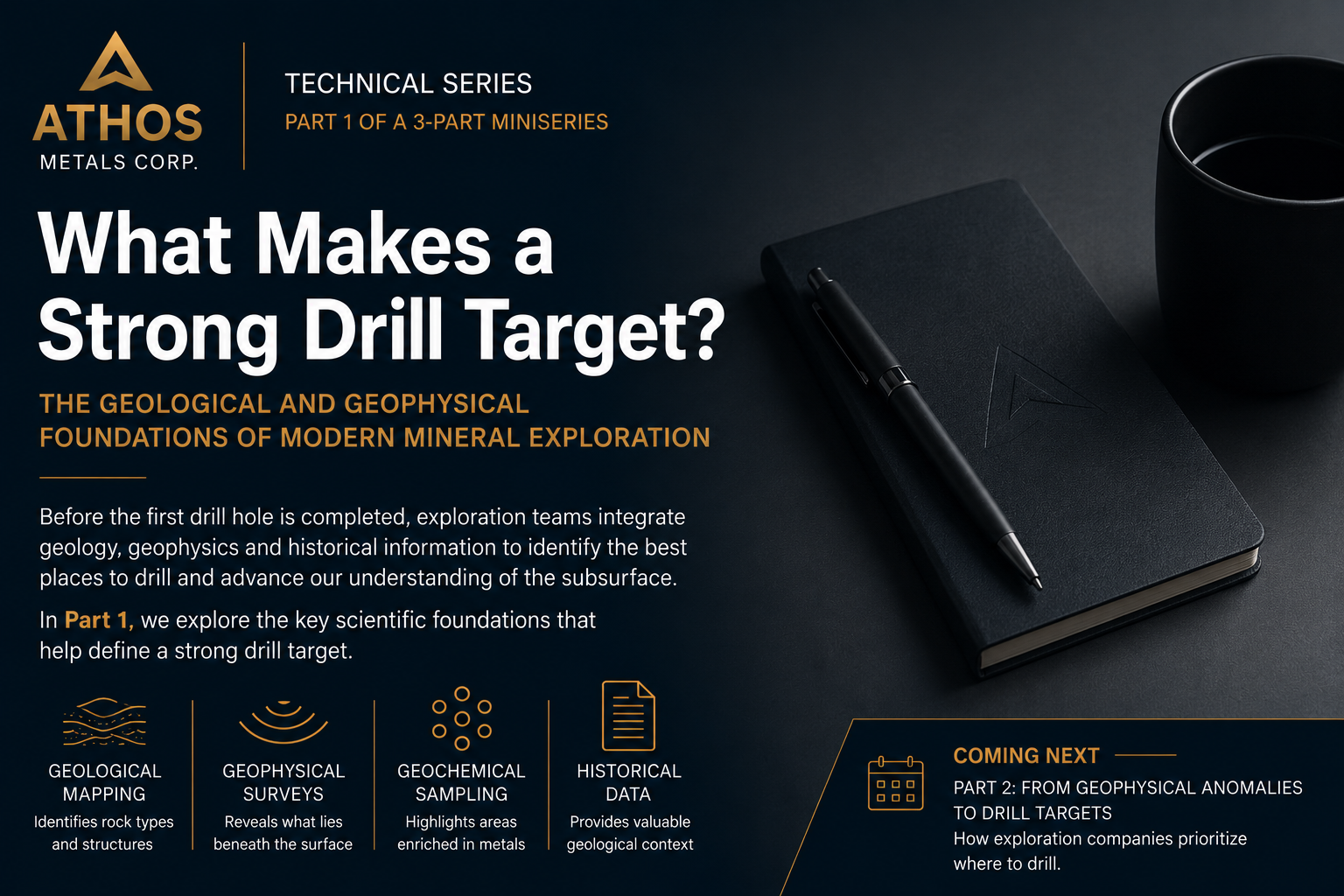
Technical Series | Part 1
What Makes a Strong Drill Target?
The Geological and Geophysical Foundations of Modern Mineral Exploration
Every mineral discovery begins long before the first drill hole is completed. Before exploration companies commit the significant time, capital and technical resources required for drilling, they must first determine where drilling has the greatest probability of improving their understanding of the subsurface.
This process is known as target generation—the systematic evaluation of geological, geophysical and historical information to identify locations most likely to test a geological model successfully. Rather than relying on a single promising anomaly, modern exploration programs seek multiple independent lines of evidence that support the same geological interpretation.
For exploration geologists, a strong drill target is rarely defined by one dataset alone. Geological mapping identifies favourable rock types and structures. Geophysical surveys reveal physical characteristics beneath the surface that cannot be observed directly. Historical exploration provides valuable geological context, while geochemical sampling may identify areas enriched in metals. Individually, each dataset contributes important information; together, they allow exploration teams to prioritize targets with greater technical confidence.
This integrated exploration philosophy forms the foundation of Athos Metals Corp.’s exploration strategy at the Empire District Project in Northwestern Ontario. The Company recently completed a district-scale VTEM Plus airborne electromagnetic and magnetic survey across the Empire, Rambler and Mack properties to further refine its geological understanding and support drill target generation. ¹
Athos has also announced plans for a minimum 2,000-metre drill program following completion of the VTEM Plus interpretation and a National Instrument 43-101 technical report outlining the proposed exploration program. ²
The Empire District encompasses approximately 24,445 hectares across the Empire, Rambler and Mack properties and is prospective for copper, nickel, platinum group elements (PGEs) and gold. ³ Located within the Canadian Shield of Northwestern Ontario, the project lies in one of Canada’s most active and well-established mining jurisdictions, an area recognized as an important component of Ontario’s Critical Minerals Strategy. ⁴ ⁵
The Geological Foundation
Every exploration program begins with a geological question:
Does the geology have the potential to host the type of mineral deposit being explored?
For copper-nickel-platinum group element (PGE) exploration, the answer often begins with identifying mafic and ultramafic intrusive rocks capable of hosting magmatic sulphide deposits. These rocks originate from metal-rich magma derived from the Earth’s mantle. As the magma cools, sulphide liquids may separate from the silicate melt, allowing nickel, copper and platinum group elements to become concentrated into sulphide-rich zones. ⁶
Not every intrusion contains economic mineralization. Consequently, geologists evaluate numerous geological characteristics before recommending a drill target, including rock composition, intrusion geometry, structural controls, sulphide textures and evidence of multiple intrusive events. Collectively, these observations help determine whether a geological system possesses the characteristics expected of a fertile magmatic sulphide environment. ⁷
Equally important is understanding where mineralization may occur within an intrusion. Dense sulphide liquids commonly migrate toward the base of an intrusion or accumulate within embayments, feeder conduits and structural traps. Understanding this three-dimensional architecture helps geologists determine where mineralization is most likely to be concentrated before drilling begins. ⁷
Historical exploration within the Empire District has confirmed the presence of mafic-ultramafic intrusive rocks and magmatic sulphide mineralization, demonstrating that the geological processes capable of forming a magmatic nickel-copper-PGE system have occurred within the district. ⁸
Building upon this geological foundation, Athos is integrating historical geological information with modern airborne geophysical data to refine exploration models and prioritize future drill targets. ⁹
Geophysics: Looking Beneath the Surface
While geological mapping and geophysical surveys provide valuable scientific information, identifying the highest-priority drill targets requires careful interpretation and integration of multiple datasets.
Athos is currently reviewing and interpreting the results of its recently completed district-scale VTEM Plus airborne electromagnetic and magnetic survey alongside historical geological and exploration data. This is a detailed technical process that takes time, as geologists evaluate conductive anomalies, magnetic signatures and their relationship to known geology before selecting the most prospective drill targets.
Although interpretation is still underway, the Company is encouraged by the early observations and is excited about the potential of the VTEM dataset to further refine its understanding of the Empire District. As this work progresses, the results are expected to support future exploration planning while also providing important technical insights that will form the basis of Athos’ ongoing investor communications and educational marketing initiatives.
Coming Next
Athos Insights | Technical Series | Part 2
From Geophysical Anomalies to Drill Targets
How Exploration Companies Prioritize Where to Drill
In Part 2 of our Technical Series, From Geophysical Anomalies to Drill Targets, we take the next step in the exploration process and look at how geophysical anomalies are evaluated, integrated with geological and geochemical information, and prioritized into drill-ready targets. The article also explores how Athos Metals is applying this process at the Empire District Project following completion of its district-scale VTEM Plus survey.
Sources
³ https://athosmetals.com/the-empire-district-project-what-attracted-athos-metals/
⁵ https://www.ontario.ca/page/fortifying-ontarios-economy-critical-minerals
⁷ https://pubs.usgs.gov/sir/2010/5070/i/
⁸ https://www.vrr.ca/projects/empire-district
Forward-Looking Information
This article contains forward-looking statements and forward-looking information within the meaning of applicable Canadian securities laws. Forward-looking statements include, but are not limited to, statements regarding the Company’s strategy, objectives, plans, anticipated activities, future performance, timing of transactions, and expectations with respect to exploration, development, the results of the VTEM Plus survey, drill hole planning and the anticipated drill program, additional staking, the proposed qualifying transaction with Meed Growth Corp., and the Company’s plans to build on its relationship with the Lac des Mille Lacs First Nation. Readers are cautioned that geophysical anomalies identified in this article do not necessarily indicate the presence of economic mineralization, and that the interpretation of geophysical data is subject to uncertainty.
Forward-looking statements are based on management’s current expectations, assumptions, and beliefs, including assumptions regarding market conditions, regulatory approvals, availability of financing, and the Company’s ability to execute its business plans. Such statements are subject to known and unknown risks, uncertainties, and other factors that may cause actual results, events, or developments to differ materially from those expressed or implied by such forward-looking statements. These risks and uncertainties include, without limitation: the speculative nature of mineral exploration; the absence of a mineral resource estimate; uncertainty as to whether exploration activities will result in the discovery of economic mineralization; risks relating to obtaining and maintaining exploration permits and other regulatory approvals; the Company’s limited operating history and reliance on key personnel; risks relating to the availability and cost of financing; fluctuations in commodity prices; and general economic, market, and business conditions.
With respect to the proposed qualifying transaction with Meed Growth Corp., there is no assurance that the transaction will be completed on the terms described herein or at all. Completion of the qualifying transaction is subject to a number of conditions, including but not limited to, approval of the TSX Venture Exchange, completion of the concurrent financing, and satisfaction of other customary closing conditions. The qualifying transaction could be modified, restructured, or terminated.
Readers are cautioned not to place undue reliance on forward-looking statements, which are made as of the date hereof, and the Company undertakes no obligation to update or revise any forward-looking statements, except as required by applicable law or as otherwise required by the policies of the TSX Venture Exchange.